World Electricity
(test)
- 2024-01-01
1. Energy Policy of Japan
*This page has been reconstructed from the PDF version of Electric Power Industry in Japan (EPIJ) 2026.
Primary Energy Self-Sufficiency
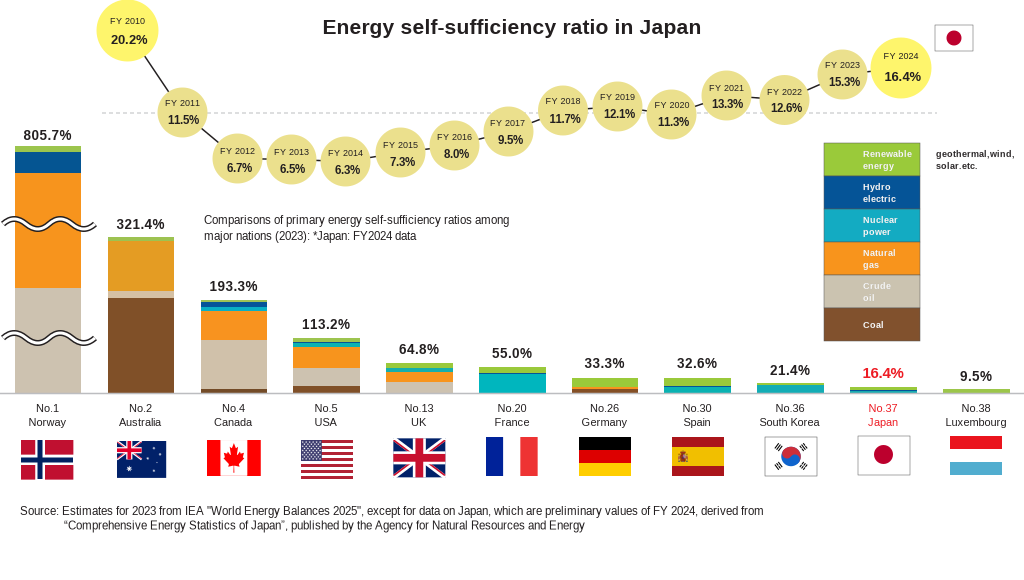
In FY2024, Japan's energy self-sufficiency ratio was 16.4%, lower han those of other OECD countries.
Once imported, uranium can support stable electricity generation for extended periods. As a quasi-domestic energy source that can be reprocessed and recycled, nuclear energy plays an important role in Japan's energy security.
Primary Energy Mix and Fuel Import Partnersy
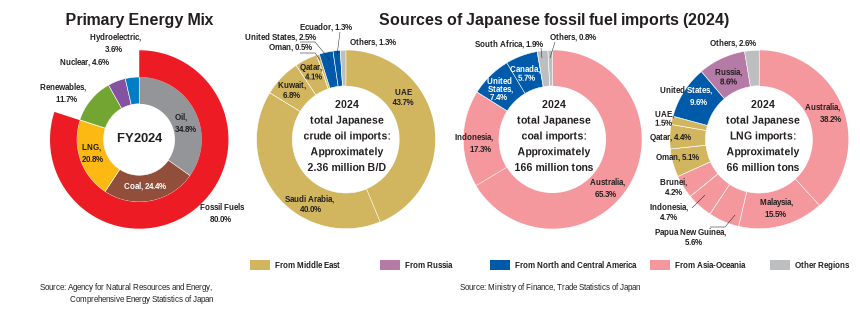
Fossil fuels account for 80% of Japan's primary energy supply.
Due to its limited domestic resources, Japan imports nearly all of its fossil fuels.
Efforts have been made to diversify LNG supply sources and contract structures.
LNG imports from Canada commenced in 2025.
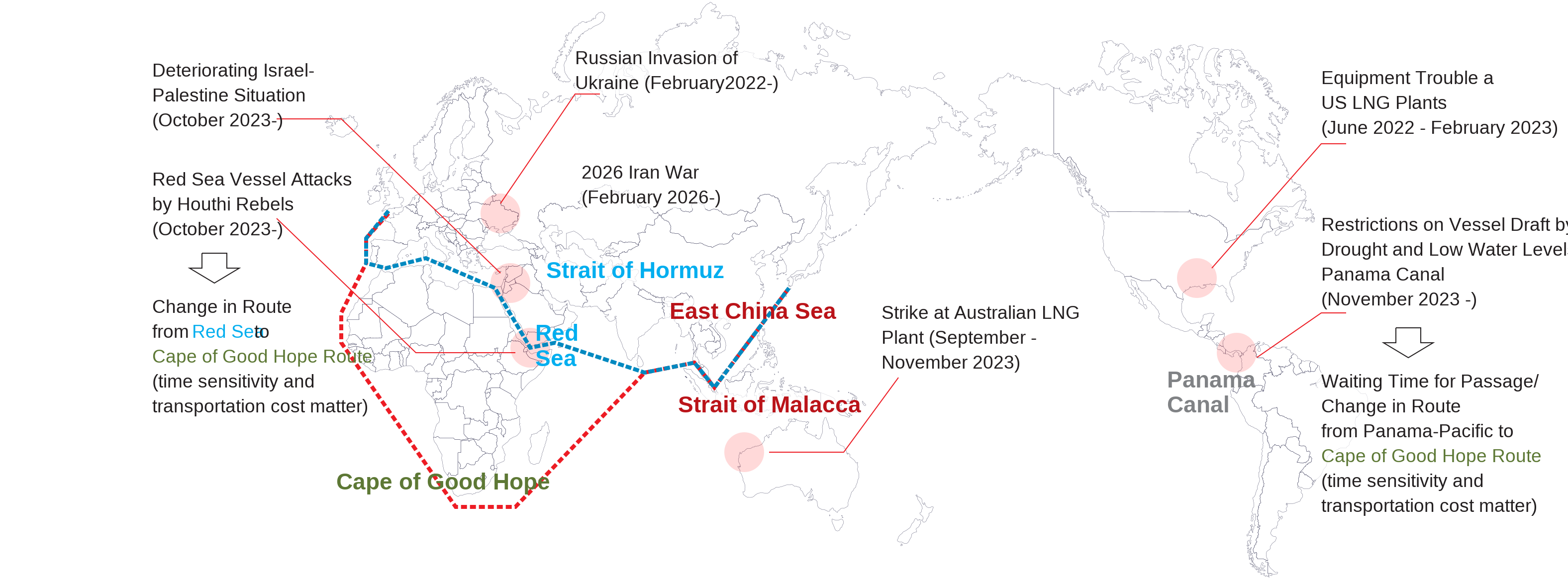
Geopolitical Risks of Fossil Fuel Transport
Maritime routes from the Middle East include chokepoints such as the Strait of Hormuz, Strait of Malacca, and the East China Sea, posing significant geopolitical risks.
In the current Iran war, the Strait of Hormuz has effectively become unnavigable, severely disrupting energy supply chains and tightening oil and electricity supplies across countries.
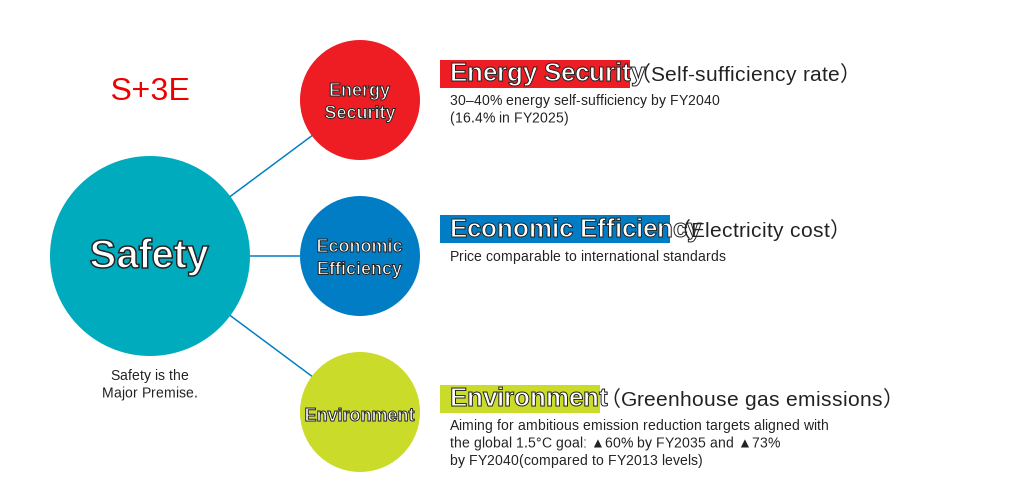
Basic Principles of Energy Policy: S+3E
As Japan is a country with limited natural resources, it is essential to create a multi-layered energy supply structure which balances the aspects of S+3E; safety, stability of supply, economic efficiency, and environmental sustainability.
Rather than relying on a specific energy source, Japan seeks to pursue a well-balanced energy mix from the perspective of S+3E.
The 7th Strategic Energy Plan
The basic direction of the national energy policy
Changes since the 6th Revision
Increased economic security demands
Expected increase in electricity demand due to the progress of DX, GX
Expanding diverse and realistic approaches while maintaining ambitious goals toward realizing carbon neutrality
Policy Direction toward 2040
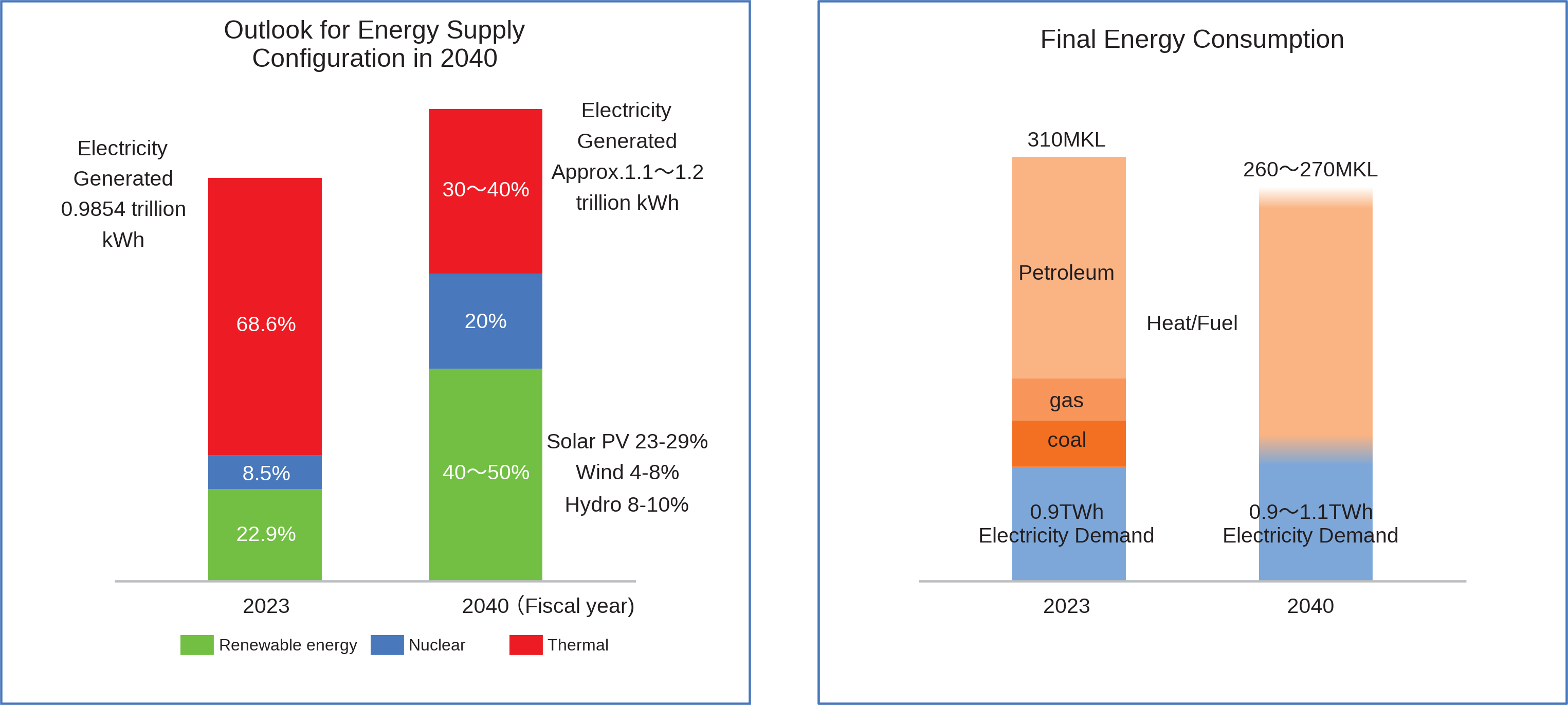
73% reduction in GHG emission compared to FY2013
Maximize the use of decarbonized energy sources that contribute to energy security
Balanced power generation mix
| Source:METI | |
Renewable |
|
Nuclear |
|
Thermal |
|
The energy supply and demand outlook for 2040 is based on multiple scenarios.
There are various uncertainties.
The outlook is affected by trends in innovative technology.
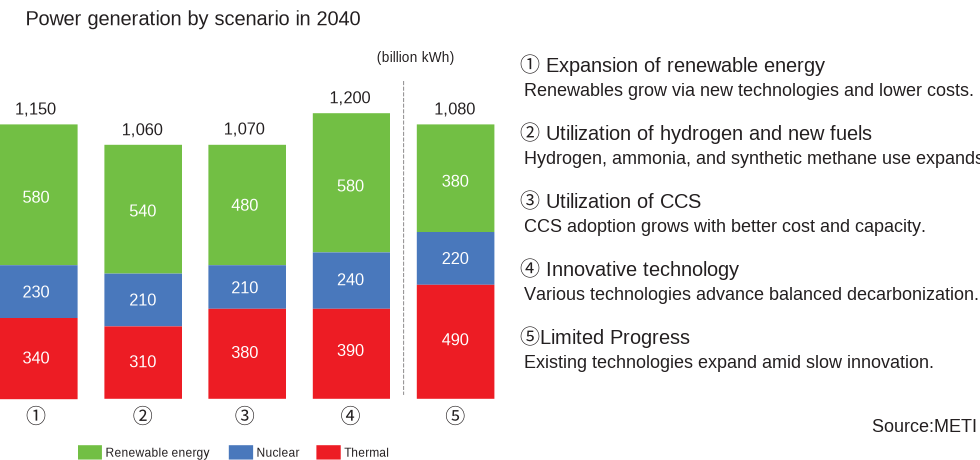
In addition to the scenario achieving a 73% reduction by fiscal year 2040, a reference scenario ⑤ that falls short of this target (achieving a 61% reduction) is also presented.
In this case Natural gas primary energy supply is about 74 million ton.
Some critical minerals are dependent on specific countries, it is important to take measures to ensure a stable supply, including diversification of supply sources.
Economic Security Promotion Act of 2022 identified the critical products with strategic importance. Policy for Securing Stable Supply of Critical Minerals of 2023 set the procurement targets required for domestic production in 2030.

GX 2040 Promotion Strategy - Key Laws & Policies
| Policy/Legislation | Key Content | |
| GX Promotion Act (Enacted 2023) | Issuance of GX Bonds (20 trillion yen); Introduction of carbon pricing (ETS, fossil fuel surcharge);Establishment of GX Acceleration Agency; Total GX investment target of 150 trillion yen over 10 years (public and private) | |
| GX Act Amendments (Amended 2023) | Legalization of ETS (mandatory from FY2026); Fossil fuel surcharge from FY2028; Strengthened financial support for GX investment | |
| GX Decarbonization Power Supply Act (Enacted 2023) | Electricity Business Act (Amended) | Sets nominal reactor life at 40 years; up to 20-year extension possible with METI approval based on GX contributions and safety upgrades. Unforeseen non-operational periods not counted toward limit. |
| Atomic Energy Basic Act (Amended) | Clarifies fundamental nuclear policy: safety-first, energy security and GX role, and institutional responsibility. | |
| Reactor Regulation Act (Amended) | Requires technical assessments every 10 years after 30 years of operation; long-term management plans must be approved by NRA. | |
| Spent Nuclear Fuel Reprocessing Implementation Act (Amended) | Expands Nuclear Reprocessing Organization’s role to oversee national decommissioning, conduct joint R&D, and levy decommissioning contributions from operators. | |
| Hydrogen Society Promotion Act (Enacted 2024) | Defines basic policies and business approval scheme; Subsidizes price differences between hydrogen and existing fuels; Allows regulatory exemptions; Sets operational criteria for hydrogen suppliers. | |
| CCS Business Act (Enacted 2024) | Licensing systems for storage and trial drilling; Legal frameworks for storage/drilling rights; Regulations for CCS and CO2 pipelines. | |
| Source:METI | ||
GX 2040
Revision of the Strategy for Promoting Transition to a Decarbonized Growth-Oriented Economic Structure
Expand inter-regional lines, install storage facilities, and use smart grids to balance supply and demand.
Promote wind, geothermal, and storage through FIP (market + premium); reform capacity market to support hydrogen and CCUS-equipped thermal.
Strengthen LNG contracts (Middle East, U.S., Australia)
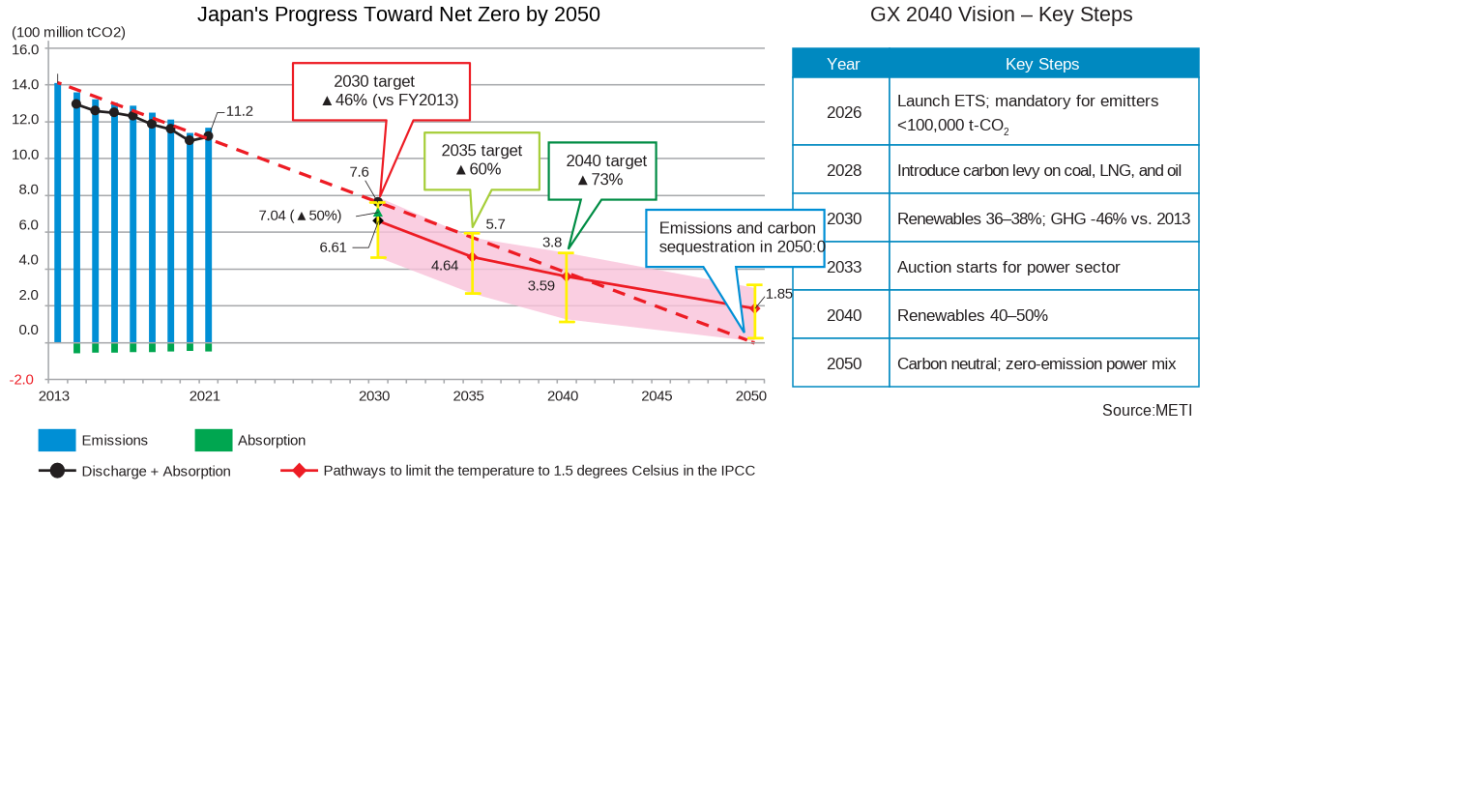
Future Energy Strategy, Pro-Growth Carbon Pricing Framework
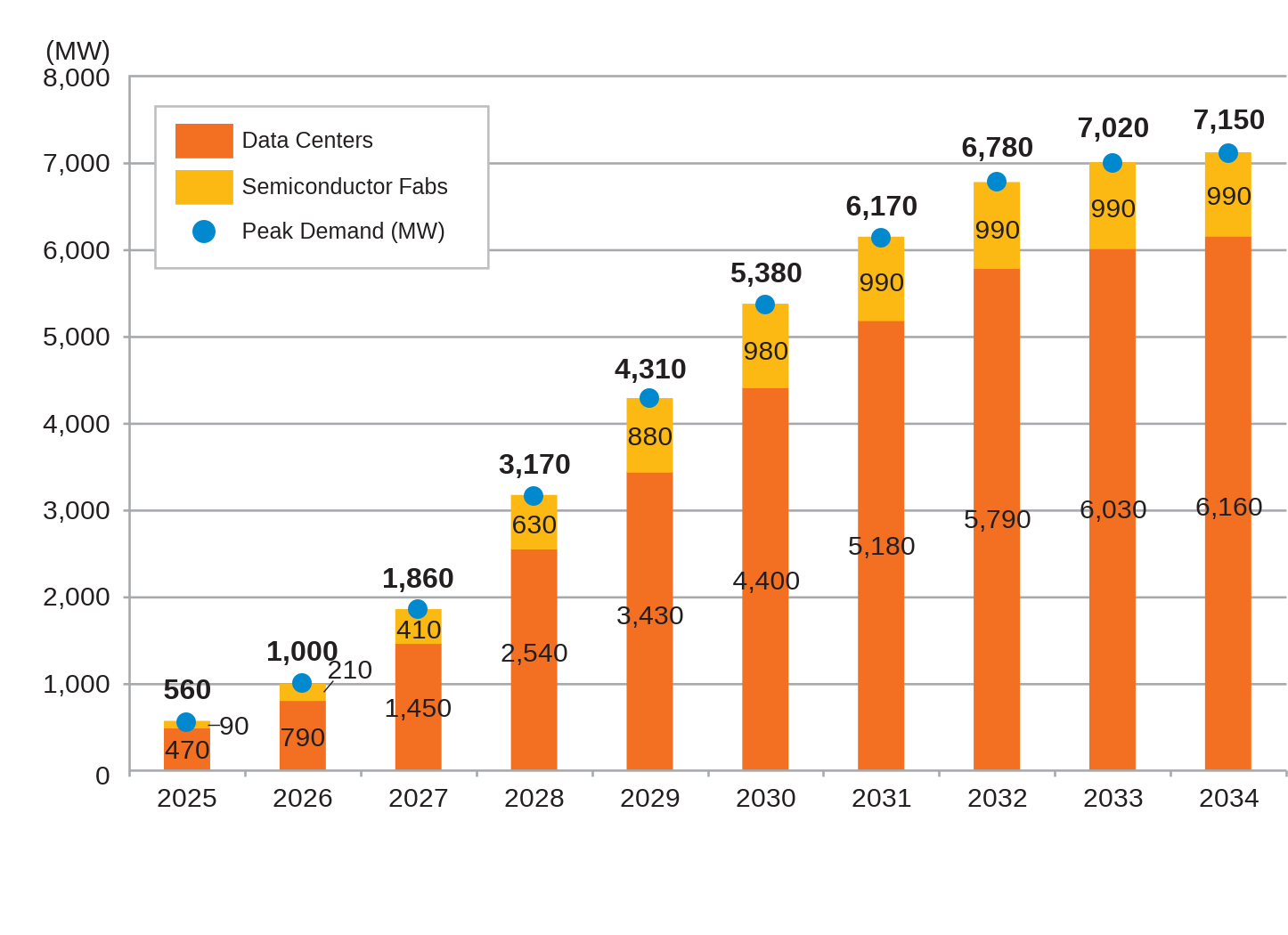
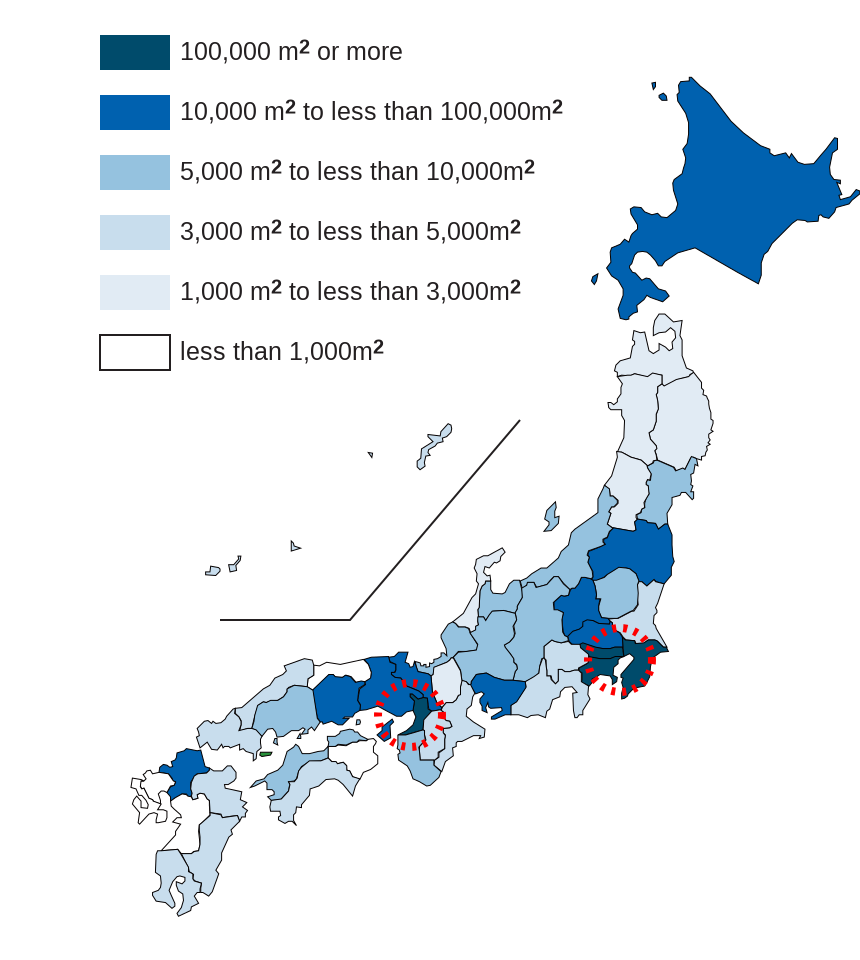
AI/Data Center Electricity Demand:DC/AI power demand projected to increase towards 2050, Promote regional DC siting and decarbonized power supply integration
Green Industrial Policy: Support hydrogen-based steel and low-carbon materials, Leverage corporate and public procurement
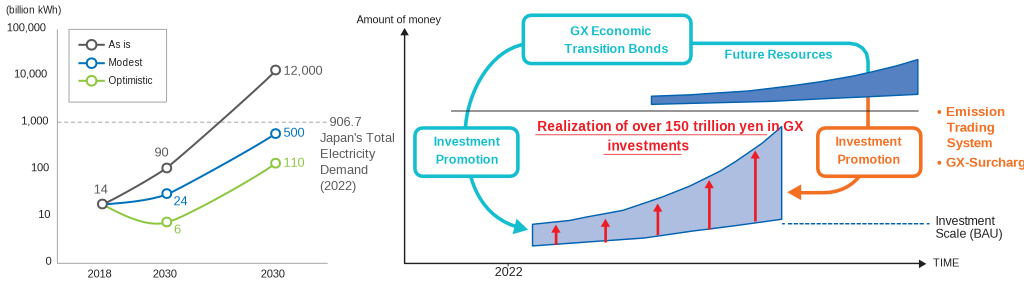
GX bonds finance upfront decarbonization investments to support industrial transition.
The GX-ETS was launched in FY2023 on a voluntary basis, with approximately 700 companies participating, covering over 50% of national emissions.
From FY2026, participation is mandatory for entities emitting over 100,000 tCO2, with approximately 300-400 companies, covering around 60% of emissions.
GX bonds are expected to be repaid through revenues from the fossil fuel surcharge introduced in FY2028 and allowance auction revenues generated by auctions for power generators under the GX- ETS, which are scheduled to commence in FY2033.
The Takaichi Administration’s Energy Policy
Stricter RE Governance with Continued Decarbonization
Energy security and improving Japan’s energy self-sufficiency are the administration’s top priorities.
The Takaichi administration is expected to tighten oversight of renewable energy deployment while maintaining Japan’s broader decarbonization goals.
The administration's policy approach combines short-term solar governance with a long-term support for nuclear power and emerging technologies.
| Topic | Policy direction | Key challenge |
| Renewable energy | Review subsidies and strengthen regulations on mega-solar and other renewable installations | Environmental damage, landscape concerns, disaster risks, China dependency, and future panel disposal must be addressed to sustain public support |
| Nuclear power | Promote nuclear utilization and support next-generation advanced reactors | Restarting and replacing plants remain uncertain due to safety requirements and public concern |
| Emerging technologies | Accelerate commercialization of perovskite solar cells and fusion energy | Fusion still faces major technical and cost uncertainties; timing of deployment is unclear |
| Climate policy framework | Continuously pursuing Green Transformation, carbon neutrality by 2050, and the FY2030 emissions reduction target | Policy consistency is importat, but implementation must avoid public opposition and industrial disruption |
| Broader environmental policy | Strengthen climate adaptation and national resilience | Disaster prevention, measures against extreme heat, and adaptation in agriculture/forestry/fisheries will become increasingly important |
| Source:METI | ||
Data Center Demand Growth and Key Challenges
Data center demand in Japan is expected to rise sharply, driven by AI, digitalization, and new large-scale facilities.
The main challenge is securing power supply to meet growing demand, including from industrial sectors such as semiconductors and, potentially, iron and steel as the sector shifts toward electric arc furnaces. Other challenges that need to be addressed include grid constraints, interconnection rules, and siting, including the geographic dispersion of data centers.